Why Contractors Need Better Equipment Maintenance Software
Posted by james thomas
Filed in Technology 381 views
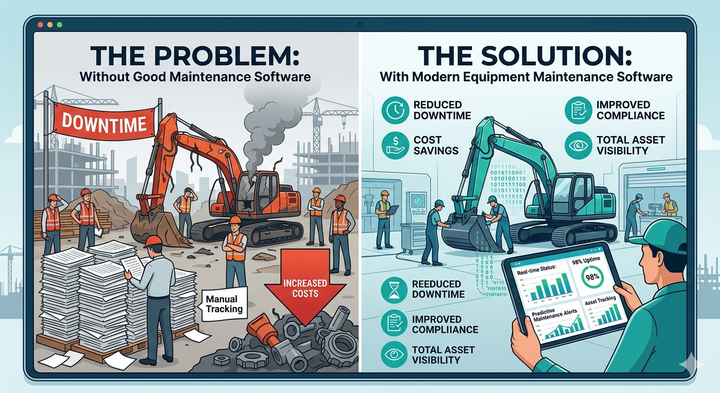
Contractors do not lose money only when equipment breaks. They lose money when crews wait, rentals run longer than planned, parts are missing, inspections get delayed, and service history lives in someone’s notebook, phone, or memory. Clue’s construction equipment maintenance software helps contractors move from reactive repairs to planned maintenance, cleaner records, and better equipment uptime.
For equipment-heavy construction teams, maintenance is no longer a side task. It directly affects production, safety, job costing, and schedule control. The global construction equipment repair and maintenance service market was valued at USD 34.6 billion in 2024, with growth projected from 2025 to 2034 as equipment ages and demand for maintenance support increases. That tells the real story: contractors are spending serious money to keep assets running, and the old way is not holding up.
Maintenance Problems Are Bigger Than Repairs
Many contractors still manage equipment maintenance through spreadsheets, whiteboards, paper forms, text messages, and disconnected systems. That may work for a small fleet, but it becomes messy fast when assets are spread across multiple job sites.
The problem is not just a missed oil change. The bigger issue is lack of visibility. Managers may not know which asset is due for service, which unit failed inspection, which parts are available, or which repair costs keep repeating. By the time the issue becomes obvious, the job site has already felt the hit.
Better maintenance software gives contractors one place to track service schedules, work orders, inspections, parts, labor, repair history, meter readings, and costs. That creates a more reliable maintenance process instead of relying on whoever remembered to update the spreadsheet.
Reactive Maintenance Costs More
Waiting until equipment fails is one of the most expensive ways to run a fleet. A breakdown does not only create a repair bill. It can delay crews, disrupt sequencing, increase rental costs, and push supervisors into last-minute problem-solving.
McKinsey has reported that maintenance costs can represent 20% to 60% of overall operating expenditure depending on the industry and asset type. It also noted that advanced companies using technology-enabled maintenance approaches have achieved 20% to 30% maintenance cost reductions. Construction contractors should not ignore that. Equipment maintenance is not just a shop issue. It is an operating-cost issue.
A better system helps contractors shift from reactive to preventive maintenance. Instead of waiting for an asset to fail, teams can schedule service based on engine hours, mileage, calendar intervals, inspection results, telematics data, or manufacturer recommendations.
Preventive Maintenance Needs Better Tracking
Preventive maintenance sounds simple on paper. Change filters, check fluids, inspect components, service assets on time. In the field, it gets harder. Equipment moves. Operators change. Jobs run late. Service windows shrink. Paper forms disappear.
That is where software becomes useful. Construction equipment maintenance software helps teams track service intervals and trigger alerts before small issues become larger repairs. It can also help maintenance managers prioritize what needs attention first.
A strong preventive maintenance workflow may include:
-
Automatic service reminders based on hours, miles, or dates
-
Digital inspection forms for operators and technicians
-
Work order creation from failed inspections
-
Maintenance calendars for planned service
-
Parts and inventory tracking
-
Labor and repair cost records
-
Asset service history
-
Mobile access for field teams
The goal is not to create more admin work. The goal is to make maintenance predictable, visible, and easier to execute.
Field Teams Need Mobile Access
Construction does not happen behind a desk. Maintenance software needs to work where the equipment is: on job sites, in yards, in service trucks, and in the shop.
Mobile access allows operators to complete inspections, report defects, attach photos, submit meter readings, and flag issues before they become downtime. Technicians can view work orders, service history, assigned tasks, required parts, and repair notes without calling the office every fifteen minutes.
This matters because information loses value when it arrives late. A defect reported during a morning inspection is useful. A defect discovered after the asset fails during production is expensive. Good software shortens the distance between the field and the maintenance team.
Maintenance Data Improves Job Costing
A contractor cannot control equipment costs if those costs are invisible. Repairs, labor, parts, outside service, emergency rentals, and downtime all affect profitability. When maintenance data is disconnected from job costing, managers may underestimate the real cost of keeping assets active.
Better software helps track maintenance expenses by asset, project, category, technician, vendor, and repair type. Over time, this data shows which assets are reliable, which ones are draining the budget, and which jobs are harder on equipment.
That insight helps contractors answer practical questions:
-
Which assets cost the most to maintain?
-
Which repairs keep repeating?
-
Which equipment should be replaced instead of repaired again?
-
Which job sites are driving higher service costs?
-
Which vendors or parts categories are increasing expenses?
-
Which preventive tasks are reducing emergency work?
That is not theory. That is how contractors stop guessing and start managing the numbers.
Inspections Become More Consistent
Inspections are often the first line of defense against equipment failure and safety risk. But paper inspection forms are easy to skip, lose, or file away without action. A digital inspection process gives contractors cleaner documentation and faster follow-up.
When an operator reports a defect, the software can create a work order, notify the right person, and attach the issue to the asset record. This makes the process easier to track from report to repair.
Digital inspections also help managers see patterns. If the same type of defect appears repeatedly, it may point to operator training issues, harsh job site conditions, poor maintenance timing, or a deeper equipment problem.
Parts Management Reduces Delays
A technician cannot complete a repair if the right part is not available. Parts shortages are a silent cause of downtime. The asset may be in the shop, the technician may be ready, but the job still stalls because inventory was not tracked properly.
Maintenance software can help contractors manage parts usage, stock levels, purchase history, reorder points, and supplier information. This makes repair planning cleaner and reduces last-minute scrambling.
For larger fleets, parts visibility can save serious time. It also prevents overbuying, duplicate orders, and wasted shelf stock. The shop runs better when parts are managed like a real operating system, not like a junk drawer with invoices.
Better Software Supports Better Decisions
The best maintenance software is not only a digital filing cabinet. It should help contractors make better decisions. Reports and dashboards can show downtime trends, maintenance costs, compliance status, overdue service, asset reliability, and technician workload.
McKinsey has also noted that digital and analytics tools in heavy-equipment maintenance can fall short when implementation is weak, especially when companies focus on technology without redesigning workflows. That point matters. Software alone does not fix maintenance. Contractors need clear processes, trained users, clean data, and accountability.
A strong system should fit how construction teams actually work. It should not add friction to the field. It should make service scheduling, reporting, inspections, and cost tracking easier.
Conclusion
Contractors need better equipment maintenance software because equipment downtime is not a small inconvenience. It affects schedules, crews, safety, rentals, repair costs, and profit margins. Paper systems and scattered spreadsheets cannot keep up with modern construction operations.
Construction equipment maintenance software gives contractors a better way to plan service, track inspections, manage work orders, control parts, monitor costs, and improve uptime. The contractors who win are not the ones who repair equipment the fastest after everything breaks. They are the ones who see problems coming and act before the job site pays the price.