Football Jersey Size Chart Workflow Every Team Coordinator Should Master | HAMCO
Posted by Imathew Jaxson
Filed in Sports 239 views
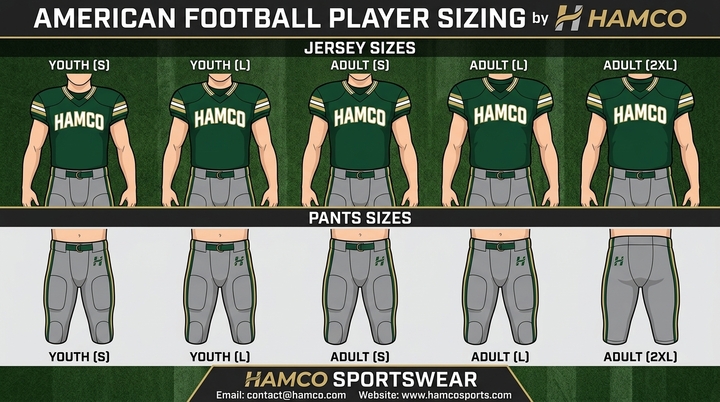
Every high school football coach knows the moment. The new uniforms have been approved. The design is locked in. Production is about to begin. And someone, usually the head coach or team coordinator, has to handle the most underrated part of the entire uniform project. Collecting accurate sizes from every player on the roster. Most coaches treat this step as a formality. The reality is that sizing collection is where most uniform projects quietly succeed or fail. Players who end up in jerseys that fit poorly do not perform their best. Coordinators who rush this step end up handling complaints, returns, and replacement orders for weeks. The fix is treating the football jersey size chart as the foundation of a real workflow rather than a quick form to fill out.
Hamco Sports has guided thousands of high school football programs through this exact process over the years. The patterns are clear. Programs that follow a structured size collection workflow end up with gear that fits cleanly across every position on the roster. Programs that wing it often end up with awkward fits, sizing complaints, and frustrated players. The investment in workflow is small. The improvement in the final result across the entire roster is significant.
Why Football Sizing Collection Is Different From Most Other Sports
Three forces make football sizing more complex than sizing for most other team sports.
The first is pad accommodation. Football jerseys must fit over substantial layers of equipment. Shoulder pads. Rib pads. Sometimes back plates. The jersey must accommodate all of this gear while still allowing the freedom of motion needed to throw, catch, block, and tackle. This means football jerseys run two to three sizes larger than typical street clothing.
The second is position variation. A lineman who carries serious upper body mass and wears thicker shoulder pads needs a different fit than a slot receiver who wears slimmer pads and prioritizes speed. A quarterback often wants room to throw freely. A linebacker often wants a slightly tighter fit so opponents have less fabric to grab on tackles. Position based variation means the size chart number alone rarely tells the whole story.
The third is roster size. A typical high school football roster includes forty to seventy players across multiple position groups. Collecting accurate sizes from every player on a roster this large requires real coordination, not just an email blast asking everyone to submit their size.
The Five Step Football Jersey Size Collection Workflow That Works
Five distinct steps make up a real football jersey size collection workflow.
The first step is providing the size chart in advance. Send the supplier's actual size chart to every player and parent before sizing day. Include both chest dimension numbers and a simple guide explaining how to read the chart. Players who arrive at sizing day already familiar with the system make the entire process faster.
The second step is measuring while players are wearing pads. The chest measurement should be taken across the widest point of the chest with the pads on, not over street clothes alone. This single step prevents the most common football sizing mistakes.
The third step is recording sizes systematically. Use a simple spreadsheet with player name, jersey number, position, chest measurement, height, weight, and recommended size. The structure makes review easier and catches outlier measurements before they become production problems.
The fourth step is double checking outliers and edge cases. Players who fall between sizes. Players whose measurements suggest they need custom sizing. Linemen who carry significant upper body mass. Each of these cases deserves a second conversation rather than a quick assumption.
The fifth step is confirming sizes with each player and parent before submitting the final order. Send the spreadsheet around for review. Encourage players and parents to flag anything that looks wrong. This final check catches the small errors that cause big headaches later.
How Hamcospo Supports the Sizing Collection Workflow
Hamcospo provides full size charts, fabric samples, and size samples for buyers who want to confirm fit before placing larger team orders. The design team also provides custom sizing options for outliers on the roster. Sizing covers youth through adult ranges with custom sizing available for players whose measurements fall outside standard ranges.
Every uniform piece uses lightweight performance polyester with moisture wicking properties. Every design is fully sublimated. Reinforced stitching at high stress points handles the demands of contact football. Cuts are pad compatible and athletic without restricting movement. Compression, traditional, and hybrid cuts are all available depending on team and position needs.
There are no minimum orders on most products. Free mockups arrive within twelve hours. Unlimited revisions are included at no cost. Standard production runs three to four weeks, with rush options for tight deadlines. The standard twenty one day design to delivery guarantee on football orders helps programs plan their season schedule with confidence.
Coaches and team coordinators can browse the full custom football uniforms collection to outfit a complete team. The catalog covers full button jerseys, pullover styles, compression jerseys, hybrid cuts, and complete team packages in youth and adult sizing.
For programs ready to invest in a coordinated jersey and pants combination, the custom professional football uniforms collection bundles both pieces in matching designs at one flat price.
Five Practical Tips for Smooth Football Sizing Collection
Five specific tips help team coordinators execute the sizing collection workflow smoothly.
The first is scheduling sizing day during a regular practice. Players are already in pads. Coaches have everyone in one place. The collection happens efficiently without requiring a separate event.
The second is using two coordinators rather than one. One coordinator handles the measuring. The other records the data. The pair works through the roster much faster than a single person handling both tasks.
The third is sizing the largest players first. Linemen and bigger players often face more sizing nuance than skill players. Handling them first lets the team build size knowledge before moving to faster paced skill player measurements.
The fourth is photographing each player after sizing. Quick reference photos help when reviewing the spreadsheet later or when the supplier asks clarifying questions about specific players.
The fifth is keeping a small inventory of spare sizes after delivery. New players sometimes join the roster mid season. Replacement pieces may be needed for damage. Having spares prevents emergencies later.
Why This Matters for Your Program
Football remains one of the most popular team sports for boys at the high school level in the United States. According to the National Federation of State High School Associations, football consistently ranks among the most played varsity sports for boys, with millions of athletes participating across the country every season. Beyond traditional tackle football, the rapid growth of flag football and seven on seven competition continues to expand the broader football landscape.
Every one of those programs needs jerseys that fit properly. A thoughtful approach to the football jersey size chart workflow at the start of the process saves serious headaches later. The investment in workflow is small. The payoff in fit, comfort, and player confidence across the season is significant.
Conclusion
Football jersey sizing is one of the most underrated parts of any custom uniform project. Programs that follow a structured workflow consistently end up with better fitting gear than programs that rush through the process. The investment in workflow planning is small relative to the long term value the right fit delivers across multiple seasons. For coaches, team coordinators, and program leaders ready to handle their next sizing collection the smart way, working with a real custom football supplier like Hamcospo is one of the most reliable moves you can make. The result is gear that fits cleanly, performs well, and represents your program properly across every game and practice for years to come.