MTCTE vs BIS CRS Certification: Which One Does Your Product Actually Need?
Posted by mtcte Certification
Filed in Other 3 views
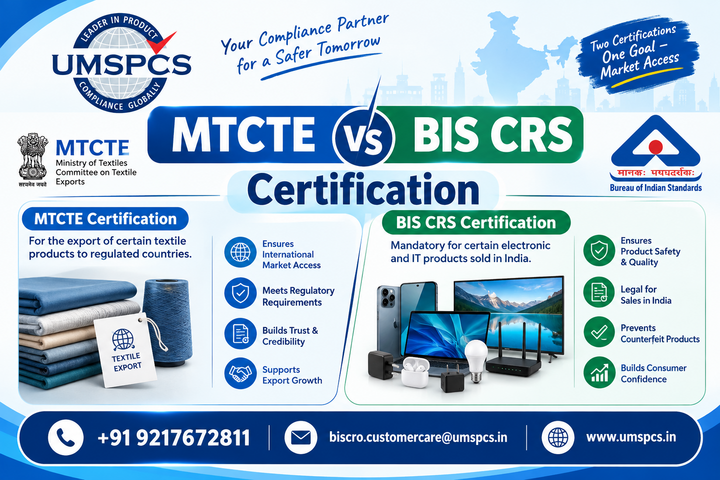
If you're bringing an electronics or telecom product into the Indian market, you've probably run into two acronyms that sound similar but mean very different things: MTCTE and BIS CRS. Confusing the two or worse, applying for the wrong one can delay your customs clearance by months and cost you real money. At UMSPCS, we get this question almost every week from manufacturers, importers, and brand owners who are trying to figure out which certification path applies to them. So let's clear it up, once and for all.
What Is MTCTE?
MTCTE stands for Mandatory Testing and Certification of Telecom Equipment. It's a regulatory scheme run by the Telecommunication Engineering Centre (TEC), which functions under India's Department of Telecommunications. If your product connects to India's public telecom network — think routers, sw itches, IP phones, base stations, GPON/ONT devices, modems, IoT gateways, or 4G/5G equipment you need MTCTE certification before that product can be legally sold, imported, or deployed in the country.
The process works like this: your product gets tested at a TEC-designated Conformity Assessment Body, or at an accredited lab in a country that has a Mutual Recognition Arrangement with India. TEC has published Essential Requirements for each equipment category, coverin g safety, electromagnetic compatibility, interoperability, and in some cases, security. Once your product clears testing, it's issued a Certificate of Conformity Assessment, and it needs to carry the TEC label along with an approval number. These certificates are generally valid for five years.
One useful shortcut worth knowing: TEC now accepts a valid BIS safety certificate or a BIS-recognised lab's safety report to fulfil the safety-related Essential Requirements under MTCTE. That overlap trips a lot of applicants up, and it's part of why the two schemes get confused in the first place.
What Is BIS CRS Certification?
BIS CRS (Compulsory Registration Scheme), sometimes called BIS Scheme II or simply BIS registration, is run by the Bureau of Indian Standards. It was introduced back in 2012, initially covering 15 product categories, and has expanded steadily since then. BIS CRS mainly targets IT, electronics, and lighting products — laptops, power banks, printers, monitors, LED products, and similar consumer electronics.
Unlike MTCTE, BIS CRS Registration has nothing to do with telecom network connectivity. Its focus is product safety and quality — things like electrical safety, fire risk, and build standards. If you're importing servers, laptops, or general electronics that don't connect to India's telecom network, BIS certification (rather than MTCTE) is usually what customs will ask for. BIS registrations are typically valid for two years and require renewal to stay compliant.
The Real Difference, In Plain Terms
Here's the simplest way to think about it: MTCTE asks, Does this device talk to India's telecom network, and is that connection safe and interoperable?" BIS CRS asks "is this electronic product itself safe to manufacture, sell, and use?"
A smart meter or an IoT gateway that transmits data over a cellular network will typically need MTCTE. A laptop or an LED bulb sitting on a shelf, with no telecom-network connection, will typically need BIS CRS. Some products — like certain networking devices — can actually need both certifications, since a device can be a safety-regulated electronic product and a telecom-network endpoint at the same time.
Getting this distinction wrong is one of the most common (and expensive) mistakes we see at UMSPCS. Applicants sometimes submit a BIS CRS application for a product that's actually a TEC-regulated telecom device, only to have the shipment held at customs while they scramble to redo the paperwork under the correct scheme.
Why This Matters for Your Business
Since the Telecommunications Act, 2023 came into force, selling, importing, or deploying notified telecom equipment in India without a valid MTCTE certificate is not just a compliance gap — it's illegal. Customs authorities are increasingly strict about checking certification type against product category, so getting it right the first time isn't optional if you want predictable timelines.
That's exactly where a consultancy like UMSPCS earns its keep. We help manufacturers, importers, and foreign OEMs (through Authorised Indian Representatives) figure out which scheme actually applies to their product, prepare the technical documentation, coordinate with designated labs, and file correctly on the MTCTE or BIS portal the first time around — so shipments don't sit in a customs warehouse while someone reads through TEC circulars.
Conclusion
MTCTE and BIS CRS aren't competing certifications — they regulate two different things entirely. MTCTE is about telecom-network safety and interoperability, overseen by TEC. BIS CRS is about general product safety for electronics, overseen by the Bureau of Indian Standards. Some products need one, some need the other, and a few need both. The key is knowing which bucket your product falls into before you file — not after your shipment gets stuck at the port. If you're unsure where your product lands, (UMSPCS)can walk through the category with you and map out the exact certification path, documentation, and timeline you'll need.
FAQs
1. Can a product need both MTCTE and BIS CRS certification?
Yes. A device that connects to India's telecom network and also falls under a BIS-regulated electronics category may need both certifications simultaneously.
2. How long does MTCTE certification take?
Timelines vary by product category and lab availability, but it typically takes several weeks to a few months, factoring in lab testing, documentation review, and TEC approval.
3. Is a BIS certificate a substitute for MTCTE?
Not entirely. However, TEC does accept a valid BIS safety certificate or safety test report to satisfy the safety-related Essential Requirements within an MTCTE application.
4. What happens if I sell telecom equipment without MTCTE certification?
Under the Telecommunications Act, 2023, selling, importing, or deploying notified telecom equipment without a valid Certificate of Conformity Assessment is illegal in India.
5. How long is a BIS CRS registration valid?
BIS CRS registrations are generally valid for two years, after which renewal is required to remain compliant.
6. Who can help me figure out which certification my product needs?
UMSPCS specialises in exactly this — evaluating your product category, identifying whether MTCTE, BIS CRS, or both apply, and managing the certification process end to end.