ZATCA E-Invoicing Saudi Arabia: Updates and Trends 2026
Posted by SowaanERP Saudi
Filed in Technology 5 views
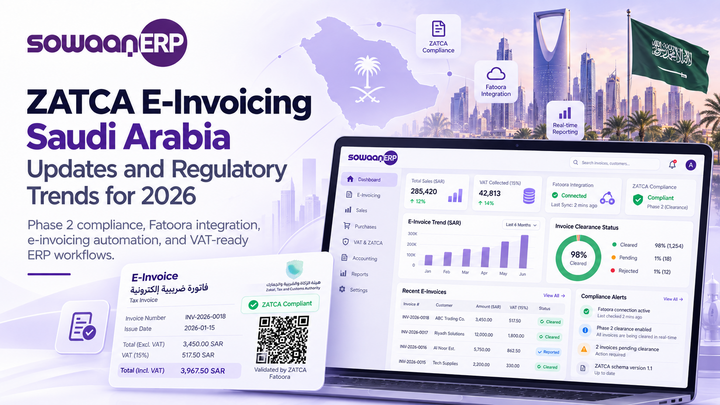
ZATCA e-invoicing Saudi Arabia requirements are a testament to Saudi Arabia's ongoing effort to strengthen its digital tax infrastructure. The Zakat, Tax and Customs Authority (ZATCA) launched e-invoicing to enhance tax compliance, boost transparency, safeguard consumers, and advance the Kingdom's digital transformation initiatives.
E-invoicing is no longer just a digital version of paper invoices. It has become an important part of business's financial operations in the Kingdom. Throughout the remainder of 2026, companies must keep abreast of updates to regulations, integration needs, and technologies to stay compliant.
Understanding the ZATCA E-Invoicing Requirements
ZATCA's e-invoicing framework is consisted of two main stages: the Generation Phase and the Integration Phase.
The Generation Phase, also called 'Phase One' was made mandatory on 4 December 2021. It mandates use of electronic solutions compliant with the law, as opposed to hand-written invoices, text-editing software or spreadsheets, for creation and storage of electronic invoices by applicable taxpayers.
The Integration Phase, Phase Two, started from January 1, 2023 and will be rolled out in waves. In this stage, taxpayers are required to connect electronic invoicing solutions to ZATCA's Fatoora platform and issue invoices based on the technical requirements set by the ZATCA.
What Will Change in 2026
The most significant development in 2026 will be the further growth of Phase Two. ZATCA keeps conducting successive waves of identification on taxpayers according to various criteria including VAT subject revenues.
In July 2026, for instance, ZATCA announced its Twenty-Fifth Wave. The tax wave includes taxpayers whose VAT subject revenues were more than SAR 187,500 in the years 2022, 2023, 2024 or 2025. By February 1, 2027, targeted taxpayers must have integrated their e-invoicing systems with Fatoora.
This shows that companies shouldn't presume that smaller companies aren't being included in future integration needs. It is important for companies to watch the notifications given by the ZATCA and determine if they meet the requirements of a future wave by reviewing their revenue profile.
Fatoora Integration and Technical Compliance
The integration with Fatoora is one of the key requirements of Phase Two. Businesses must have an electronic invoicing solution which can communicate with the ZATCA systems through the technical infrastructure required by the ZATCA.
Phase Two will also bring new invoice requirements such as specific invoice formats, as well as new invoice fields. The businesses may also have varying needs for clearance and reporting depending on the type of transaction.
The technical guidance provided by ZATCA clarifies how integration occurs via an API, and how electronic invoices have to be created and kept in the appropriate format. Tax invoices to be cleared must be presented with the Authority for clearance prior to sharing with buyers.
Why ERP Software Is the Answer to Compliance
When dealing with a huge volume of invoices, using isolated invoicing solutions can introduce needless compliance challenges. ERP software can integrate the sales, accounting, inventory, purchase and invoicing functions into a single system.
An appropriate ERP solution can assist the businesses with automated invoice generation, customer and product information, calculation of VAT, transaction recording and e-invoicing in accordance with ZATCA requirements.
It is especially beneficial to businesses looking for ERP software Saudi Arabia solutions, as compliance shouldn't be a standalone process, but a routine part of financial operations.
Greater Attention to Data Accuracy
An additional trend is the rising significance of correct business data. E-invoicing systems rely on the same information as a traditional invoice: VAT registration numbers, customer information, products, tax codes, invoice values, and transaction dates.
Bad master data can lead to invoice inaccuracies and delays. Companies should, therefore, check the customer, supplier, product and tax records periodically.
While automation can minimize manual errors, it doesn't negate the need for good data governance.
Getting Ready for Future ZATCA Waves
This should not be a requirement for businesses to wait for a notification from ZATCA to review their systems. This can involve a review of the existing invoicing process, verification of VAT information, examination of ERP functionality, integration testing, and finance team training.
Businesses should also have a good system of keeping up with their invoices and have a process for credit notes, debit notes, rejected invoices and interruptions in the system.
The Future of E-Invoicing in Saudi Arabia
In the context of a shift to a digitally connected tax administration, ZATCA e-invoicing Saudi Arabia requirements have been introduced. During Phase Two, compliance is likely to be a more central part of the businesses' accounting and ERP systems, as the expansion of Phase 2 continues.
For Saudi businesses, the key is to view e-invoicing as more than just a compliance requirement—it's a chance for financial automation. An ERP system can take care of all your invoicing, accounting, VAT, reporting and operational data from a single place, helping you manage things at a modern level.
Companies that invest in both proper technology and correct processes will be better prepared to comply with future ZATCA requirements, and be more efficient in their finance operations.