Zero Thermal Expansion Ceramics Market Set to Hit USD 760 Million by 2034 at 5.9% CAGR
Posted by ayush behra
Filed in Business 31 views
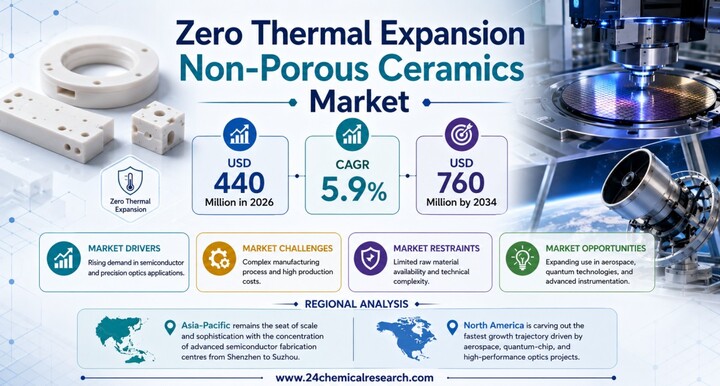
According to 24ChemicalResearch latest industry analysis, the global Zero Thermal Expansion Non‑Porous Ceramics market was valued at USD 440 Million in 2026 and is projected to reach USD 760 Million by 2034, growing at a compound annual growth rate (CAGR) of 5.9% during the forecast period. The market's expansion is fueled by expanding demand across precision equipment and high‑temperature applications, driven by the semiconductor sector's relentless pursuit of smaller nodes and the growing need for dimensional stability in aerospace, renewable energy, and biomedical implants.
View the complete report: https://www.24chemicalresearch.com/reports/304321/zero-thermal-expansion-nonporous-ceramics-market
Zero thermal expansion non‑porous ceramics are advanced materials prized for their near‑constant dimensional stability across wide temperature ranges. Their impermeability and resistance to contamination make them indispensable in ultra‑high vacuum systems, semiconductor lithography stages, and high‑precision metrology equipment. Semiconductor lithography stages, aerospace navigation optics, precision medical devices, high‑temperature heat‑sinks, and 3D‑printed custom components are growing use cases, enabling advanced performance in diverse industries. The report notes, "ZTE ceramics typically exhibit expansion rates below 2 ppm/°C, enabling near‑constant dimensions across −200°C to +800°C, a temperature span that underpins critical precision assemblies."
What Is Driving the Zero Thermal Expansion Non‑Porous Ceramics Market?
The growth of the zero thermal expansion non‑porous ceramics market is driven by a combination of rising demands in aerospace, electronics, and thermal management, expanding research and development in high‑performance applications, and a demand surge in semiconductor fine‑feature equipment.
Rising Demands in Aerospace, Electronics, and Thermal Management
Zero‑thermal‑expansion (ZTE) non‑porous ceramics are now integral to systems that operate across wide temperature ranges. In aerospace, the need for precision optics and sensor housings that remain dimensionally stable under extreme heating has pushed adoption. Similarly, mobile device manufacturers target ZTE materials to counter screen warping under rapid charging. The semiconductor industry's push for tighter tolerances in chip packaging and the automotive sector's pursuit of high‑temperature ceramic insulators reinforce this trend. These applications drive demand for sub‑1 ppm/°C expansion stability.
Expanding Research and Development in High‑Performance Applications
Innovations in HF‑R&D circles increasingly focus on alloying ZTE ceramics with novel oxides and exploring additive manufacturing routes to scale complex geometries. The push to embed ZTE components into 3‑D printed frameworks promises to reduce weight while maintaining integrity, a critical factor for space‑borne systems. Researchers are also evaluating nanoparticle doping strategies to fine‑tune thermal coefficients, offering potential cost savings by reducing the need for elaborate shielding. By extending these breakthroughs into commercial production lines, firms can capture new value streams in biomedical imaging and energy conversion.
Demand Surge in Semiconductor Fine‑Feature Equipment
The semiconductor sector remains the chief driver for zero‑thermal‑expansion non‑porous ceramics, particularly as fabrication moves toward 2 nm process nodes and sub‑5 nm nodes in leading fab facilities. Precision equipment such as wafer stages, etch chambers, and lithography tools require components that maintain dimensional stability within a few nanometers even under thermal loads exceeding 250°C. Manufacturers have recently shifted from conventional ceramic substrates to engineered zirconium‑tungstate composites, which deliver a thermal expansion coefficient below ±0.01 ppm/°C across a 300°C range. Industry data shows that equipment vendors now source zero‑expansion ceramics for roughly 60% of their new high‑precision tool line‑ups.
Market Segmentation Insights
The zero thermal expansion non‑porous ceramics market is analyzed across various segments to provide a granular view of the industry. The market is primarily segmented by type, application, and end user, revealing distinct competitive dynamics and investment opportunities within each.
By Product Type
The market is segmented into Oxide Ceramics and Non-oxide Ceramics. Oxide Ceramics dominate the market due to their facile processing, robust mechanical strength, and proven performance in extreme temperature environments. Their widespread adoption in high‑precision tools and optical components stems from well‑established supply chains and continuous material enhancements focused on reducing thermal expansion without sacrificing fatigue resistance. The non‑oxide segment, while less common, offers opportunities in high‑temperature applications where lower density or specific compositional tuning can yield superior dimensional stability.
By Application
The market is segmented into Semiconductor Manufacturing Device, Fine Checking Device, Optical & Photonic Systems, and Others. Semiconductor Manufacturing Device is the primary driver, as advanced lithography and etching systems require nanometer‑level stability that zero‑expansion ceramics uniquely deliver. Fine checking devices, such as interferometric metrology tools, also depend on non-dimensional changes to maintain measurement accuracy. Optical and photonic systems benefit from the ability of these ceramics to preserve focus and alignment over wide temperature excursions.
Regional Market Analysis
Across all global markets, the Asia‑Pacific cluster remains the seat of scale and sophistication for zero‑thermal‑expansion ceramics. The concentration of advanced semiconductor fabrication centres‑from Shenzhen to Suzhou, and downstream photolithography work‑stations‑creates a continuous stream of demand that is unmatched elsewhere. Coupled with a tightly integrated supply chain that extends from premium rare‑earth suppliers to precision sintering factories, the region delivers both the volume and the technical purity required by high‑precision equipment. Government programmes that earmark funds for next‑generation chip manufacturing and for the electrification of industrial infrastructure have further cemented confidence in domestic production, reducing exposure to geopolitical risk.
North America is carving out the fastest growth trajectory for zero‑thermal‑expansion ceramics, driven largely by a surge in aerospace, quantum‑chip, and high‑performance optics projects. Military‑grade satellite sensors and next‑generation radar arrays routinely require substrates that remain dimensionally stable across wide temperature swings, creating a persistent demand spike. At the same time, a rapid roll‑out of quantum‑computing testbeds in Boston and under‑water deep‑sea sensor arrays in Houston amplifies the need for precision, temperature‑neutral components. Meanwhile, utility companies in the U.S. are racing to convert their power grids to renewable sources, a transition that demands tightly controlled thermal budgets for solar panel mounting and energy‑storage systems.
Report Summary
The global zero thermal expansion non‑porous ceramics market is poised for steady growth, expanding from USD 440 million in 2026 to USD 760 million by 2034, driven by expanding demand across precision equipment and high‑temperature applications. The market is currently characterized by a strong focus on oxide ceramics, significant contributions from Asia‑Pacific's semiconductor fabrication ecosystem, and rapid adoption of additive manufacturing and aerospace applications.
Key Report Highlights:
-
The global Zero Thermal Expansion Non‑Porous Ceramics Market was valued at USD 440 Million in 2026 and is projected to reach USD 760 Million by 2034.
-
The market is expected to expand at a CAGR of 5.9% during the 2026–2034 forecast period.
-
Asia-Pacific remains the seat of scale and sophistication with the concentration of advanced semiconductor fabrication centres from Shenzhen to Suzhou.
-
The Semiconductor Manufacturing Device application segment is the primary driver, as advanced lithography and etching systems require nanometer‑level stability.
-
The market faces challenges including high capital investment for precision equipment, supply‑chain volatility for high‑purity raw materials, and regulatory complexity.
-
The competitive landscape is led by SCHOTT AG with roughly 35% of the global revenue share, followed by Wacker Chemie AG (~20%), with key niche players including NTK CERATEC, Nishimura Chemical, 3M, Mitsubishi Chemical Advanced Materials, and Kyocera Ceramics.
-
The report provides comprehensive insights into market size, growth forecasts, emerging technologies, regional trends, competitive analysis, key growth opportunities, and strategic developments shaping the global Zero Thermal Expansion Non‑Porous Ceramics Market through 2034.
Frequently Asked Questions Zero Thermal Expansion Non‑Porous Ceramics Market
Q: What is the current size of the global Zero Thermal Expansion Non‑Porous Ceramics market?
A: According to 24 Chemical Research, the global Zero Thermal Expansion Non‑Porous Ceramics market was valued at USD 440 Million in 2026 and is projected to reach USD 760 Million by 2034.
Q: Which region dominates the Zero Thermal Expansion Non‑Porous Ceramics market?
A: Asia-Pacific remains the seat of scale and sophistication with the concentration of advanced semiconductor fabrication centres, while North America is carving out the fastest growth trajectory.
Q: What are the key growth drivers of the Zero Thermal Expansion Non‑Porous Ceramics market?
A: The primary growth drivers include expanding demand across precision equipment and high‑temperature applications, driven by the semiconductor sector's pursuit of smaller nodes and the need for dimensional stability in aerospace, renewable energy, and biomedical implants.
Q: Which segment leads the market by product type?
A: Oxide Ceramics dominate the market due to their facile processing, robust mechanical strength, and proven performance in extreme temperature environments.
Q: Who are the leading companies in this market?
A: The market is led by SCHOTT AG with roughly 35% of the global revenue share, followed by Wacker Chemie AG (~20%), with other significant players including NTK CERATEC, Nishimura Chemical, 3M, Mitsubishi Chemical Advanced Materials, and Kyocera Ceramics.
View the complete report: https://www.24chemicalresearch.com/reports/304321/zero-thermal-expansion-nonporous-ceramics-market
Download the free sample report: https://www.24chemicalresearch.com/download-sample/304321/zero-thermal-expansion-nonporous-ceramics-market
About 24 Chemical Research
Founded in 2015, has established itself as a leading provider of chemical market intelligence, serving clients including over 30 Fortune 500 companies across North America, Europe, and Asia-Pacific. The company delivers data-driven insights through rigorous primary and secondary research methodologies.
Contact: +91 9169162030
Website: https://www.24chemicalresearch.com