About 600 Volt Building Wire (and Other Common Wire Voltage Ratings)
Posted by Electrical Wire & Cable Specialists
205 views
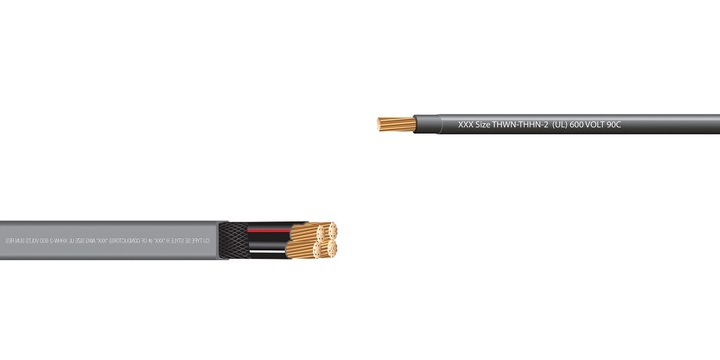
It is the case that 600 volt wire is one of the most common ratings encountered in building wire for many general power distribution installations. This short post will break down some of the details relevant to this rating and why it is so common.
What Are Voltage and Ampacity Rating?
First, we need to understand why maximum ratings for electrical potential and current are so important.
Think of electrical potential, measured in volts, as how much “pressure” is on the electricity in the wire. The higher the potential, the more the electricity wants to flow somewhere else.
Speaking of flow, that’s current. Current, measured in amps, refers to the amount of electricity that flows through the conductor at a given voltage and resistance.
So these terms are related, but think of voltage as the “force” and current as the “volume”.
Both voltage and current have a big impact on the conductor they affect. High voltage that exceeds the rating of a conductor can cause arcing and electric shock, as can high ampacity.
The other thing is that high voltage or high current, or both, which exceeds the rating of a given wire, will also overheat it, which considerably increases the risk of electrical fires.
Therefore it is critical that wherever an electrical conductor is installed, regardless of what its intended application is, its ampacity and voltage rating are not exceeded.
Why Is 600 Volt Building Wire So Common?
As for 600 volt wire that is commonly used as building wire in residential applications, it’s a very common rating because electrical service is commonly delivered to homes and businesses in America under a line voltage of 110V.
That said, there are some circuits that are delivered under 220V, which are used for large appliances that consume a lot of power.
This makes 600 volt wire a common rating because it has a voltage rating that is commonly above both of these delivery voltages, making it generally safe to use in these installations.
The rating is also high enough that, even in the event of a surge or spike, the wire shouldn’t overheat or arc, which improves safety.
What Are Some Other Common Wire Voltage Ratings?
It is also the case that 600 volt wire is not the only voltage rating you are liable to encounter.
Instrumentation and alarm cable, such as fire alarm cable, are rated generally to much lower voltage ratings since they don’t have to withstand a high voltage or carry a high current, even to power the circuits they furnish. These are commonly rated to 300V.
Much less commonly encountered is 1000 volt wire, which is generally reserved to large equipment and machinery, though it might occasionally be encountered in residential or commercial settings in photovoltaic or PV wire, which is also known as solar panel cable for its use in wiring solar energy systems.
Other medium and high voltage ratings exist, but they are generally reserved for industrial installations, to power large circuits and equipment, and are not used in the lower power applications commonly encountered in homes and most businesses.
Here for High-Quality Electrical Wire?
In the market for a new supplier of electrical wire or cable? Visit EWCS Wire. They carry a wide range of electrical wire and cable, such as 600V building wire, instrumentation and alarm cable, solar panel cable, and a number of other specialty types of wire and cable like submersible pump cable and marine battery wire.
Visit their website and get in touch with them if you have any questions about what they sell or would like to set up an account.
For more information about welding cable and Aluminum Triplex Wire Please visit: Electrical Wire & Cable Specialists.