Axe “Blade” Terminology: Understanding Basic Terms
Posted by True Swords
Filed in Business 315 views
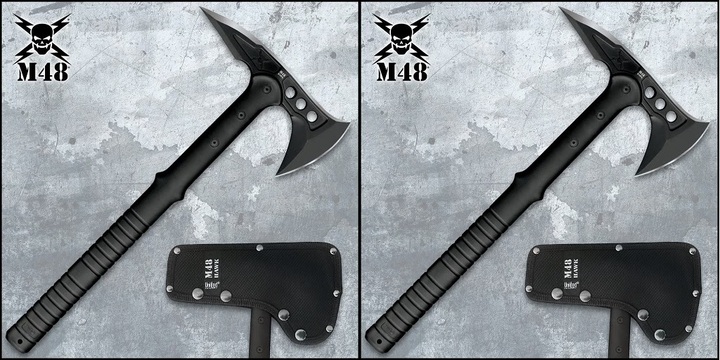
Axe terminology is a bit different from knives and other bladed tools, but these implements have a long history of use in forestry, battle, and elsewhere. One of the most iconic tools in all of human history, there are many axe blade patterns, each of which is used for different applications.
With that said, much of the terminology associated with the “parts” of an axe is in common between the different profiles. With that said, this post will break down some of the more common terms applied to axes, tomahawks, and other similar tools.
What Are the Parts of an Axe?
The major parts of nearly all axe profiles are covered below:
- Head: First off, it’s not an axe “blade”. The whole part is the head, which is made of steel and which is hung on the haft, which is the wood “handle” that a user grips. There are many different patterns of axe heads, including but not limited to bearded axes, felling axes like American and German patterns, heavy Jersey axes, and much more.
- Bit: The bit is the portion of the axe head that is flared and which contains the cutting “edge.” It is the part that is used to either split wood or make crossgrain cuts for hewing, carving, or other woodworking applications.
- Poll: The poll is the portion of the axe head opposite the bit. Many axes have a flat bit that is popular for use as a hammer or striking implement, such as for driving wedges or stakes. In some axes, instead of a flat poll there is a spike poll that can be used in lieu of a pickaroon for handling wood rounds. A special type of axe known as a Pulaski axe has an adze or mattock head opposite the bit where the poll would be. In a double-bladed axe, like a Michigan pattern axe, there is no poll, and instead there are two bits.
- Cheek: The cheek is the portion of the axe head that is flat and slopes down to the bit. Some axes have wide, flat cheeks; in others they are narrow.
- Eye: The eye is the void in the middle of the axe head through which the haft passes so that it can be secured with either a wedge or a series of wedges.
- Bevel: The bevel is the area of the cheek where it is ground down to meet the edge or bit
- Beard: In an axe head, if the bit extends down from the head such that a user’s hand could grip the throat of the haft, the axe is said to be bearded. This style is useful for hewing and for squaring logs and it enables very great control to be exercised over the axe.
- Toe: The toe is the point at the top of the bit of an axe.
- Heel: The heel is the point at the bottom of the bit; in a bearded axe the toe is the point at the bottom of the beard.
- Haft: The haft is the wooden “handle” of an axe.
Explore Axe Blades and More at True Swords
Looking for a new axe for your collection? Whether you’re here for a carving axe, hewing axe, felling axe, tomahawk, or just a replica battle axe to hang on the wall in the office, you can get what you’re looking for online at True Swords.
Visit their website and get in touch with them directly if you have any questions. They’ll be more than happy to help you find what you’re looking for.
For more information about Odachi Sword and Seax Sword Please visit: True Swords.