Cat6 UTP vs Cat6 Shielded: Which Should You Install?
Posted by sf cable
Filed in Technology 337 views
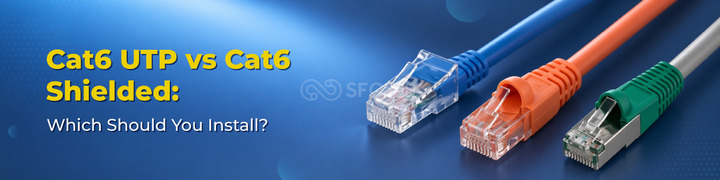
Most people don't need shielded cable. UTP works perfectly well in homes and typical office spaces where electrical interference isn't a real concern. Shielded cable earns its place in industrial settings, near heavy machinery, or anywhere dense electrical equipment is running close by.
The "just buy shielded to be safe" advice sounds reasonable, but ignores the actual trade-offs higher cost, grounding requirements, and a stiffer cable that's genuinely harder to work with.
Where are you running the cable? What's nearby? What's your budget? Answer those three honestly, and you won't need a spec sheet. This guide breaks down both options plainly what they are, where each fits, what goes wrong with the wrong choice, and how to spend your money without overdoing it.
What Is a Cat6 Ethernet Cable?
Cat6 (Category 6) is the workhorse of modern networking a copper twisted-pair cable built to handle speeds up to 10 Gbps with a 250 MHz bandwidth. Think of it as the highway your data races down every time you stream, game, or jump on a Zoom call.
In 2026, Cat6 still dominates for one simple reason: it nails the spot between price and performance. Sure, Cat6a offers better range at 10 Gbps but it costs noticeably more. Cat6 gets the job done for most homes and offices without burning a hole in your budget. With:
- 4K/8K streaming through bandwidth daily
- Online gaming demands rock-solid, low-latency connections
- Remote work is making home networks business-critical
…Cat6 keeps up comfortably, reliably, and affordably. It's not flashy it's just really good at its job.
What Is the Difference Between Cat6 UTP and Cat6 Shielded Cable?
Cat6 UTP and Cat6 shielded cables look almost identical on the outside. Same cable, same connector, same job on the surface. Cut one open, though, and they tell completely different stories.
What Is a Cat6 UTP Cable?
Cat6 UTP cable is Unshielded Twisted Pair. It means that inside this cable, copper wire pairs are twisted together, which naturally reduces crosstalk without requiring any extra protection. No foil, no braiding, no armor. Just physics doing the heavy lifting.
That simplicity is actually its biggest strength. UTP is lightweight, flexible, and installs without any drama. In homes, regular offices, and most everyday environments where heavy electrical equipment isn't part of the picture, it handles everything thrown at it without complaint.
No unnecessary complexity. Just a cable that works.
Key characteristics of Cat6 UTP Cable:
- Lightweight and flexible
- Easy to install with standard connectors
- More affordable than shielded options
What Is a Cat6 Shielded Cable?
Cat6 shielded cable takes that same basic structure and adds an extra layer of protection. This shielding can be foil (FTP) or braided (STP), depending on the type.
That added layer helps block external interference, keeping the signal stable in more demanding environments where electrical noise is a concern.
Key characteristics of Cat6 Shielded Cable:
- Extra shielding (foil or braided)
- Better protection against interference
- Requires proper grounding during installation
The shielding is the whole ballgame here. Everything else — cost, installation difficulty, flexibility — flows from that one difference.
When Should You Use a Cat6 Shielded Cable?
Now we're talking about the heavy-duty situations — where the environment itself is basically at war with your network signal.
Cat6 Shielded cable is the cable you bring when UTP would get eaten alive. Here's where it earns its keep:
Built for these environments:
- Data centers — dense racks of equipment, tons of cables, high interference
- Industrial setups — factories, manufacturing floors, anywhere heavy machinery lives
- Hospitals — medical equipment produces significant EMI, and signal stability is critical
- Server rooms — where uptime isn't optional and signal errors aren't an acceptable excuse
Why shielded wins in these scenarios:
- The foil or braid physically blocks EMI before it can reach the signal-carrying conductors
- Signal integrity stays consistent even in electrically "noisy" environments
- Data errors drop dramatically — critical when you're running servers or medical equipment
The downsides of shielded cable (yes, there are some):
- Costs more — sometimes significantly, especially at scale
- Requires proper grounding — if your shielded cable isn't grounded correctly, the shield can actually worsen interference rather than block it (awkward)
- Less flexible — the extra shielding makes it stiffer and harder to route around corners and through walls
- Needs compatible connectors — regular RJ45 connectors won't cut it; you need shielded connectors
The bottom line? Shielded is better when the environment demands it. In most home and standard office environments, UTP is not just adequate — it's the smarter, more practical choice.
What Cable Types and Variants Are Available in Cat6?
Round Cat6 — the standard, most common form; works everywhere and is built for heavy-duty runs
Flat Cat6 patch cables — same performance, slim profile; designed for spaces where round cables just don't cooperate
- Slide flat cables under carpets without lumps or trip hazards
- Tuck them behind furniture and along baseboards where round cables look clunky
- Perfect for wall routing in finished rooms — no tearing anything open
- A lifesaver for tight cable management situations where every millimeter counts
Cat6 UTP vs Cat6 Shielded Cable: Cost Comparison
Price matters — and UTP wins that round comfortably. It's cheaper per cable, which feels minor until you're wiring an entire floor. Then the gap becomes very real.
Shielded cable costs more for good reason — better materials, trickier installation, grounding requirements. But that premium only makes sense when interference is an actual problem, not a theoretical one. Factories, server rooms, buildings loaded with heavy electrical equipment — shielding pays for itself there. Everywhere else, UTP does the job without the extra spend.
Buy for your environment, not for worst-case scenarios that probably won't happen.
Are Cat6 UTP and Shielded Cables Compatible With All Devices?
Yes, both Cat6 UTP and shielded cables plug into anything with an Ethernet port — routers, laptops, gaming consoles, smart TVs — you name it. The connector is standard RJ45 across the board, so there's no compatibility headache.
The one thing worth knowing: shielded cables are a bit needy. They need proper grounding to actually do their job. Skip that step and the shielding becomes decoration. UTP, on the other hand, just works — plug it in, forget about it, get on with your life. For most homes and offices, that no-fuss simplicity is exactly what you want.
Closing Lines
Picking between Cat6 UTP and Cat6 Shielded cable isn't as complicated as it sounds — it really just depends on where you're plugging in and what's around you.
Cat6 UTP is the easygoing one. Light, affordable, simple to install, and more than capable of handling homes, offices, gaming rigs, and smart home setups without breaking a sweat.
At SF Cable, our Cat6 cables are built to actually last. No corners cut, no flimsy builds — just solid, dependable connectivity whether you're gaming, streaming, or running a full office network.
Original Article : https://www.sfcable.com/blog/cat6-utp-vs-cat6-shielded