How Application-Specific Tooling Improves Wafer Transfer Performance
Posted by Kensington Laboratories
175 views
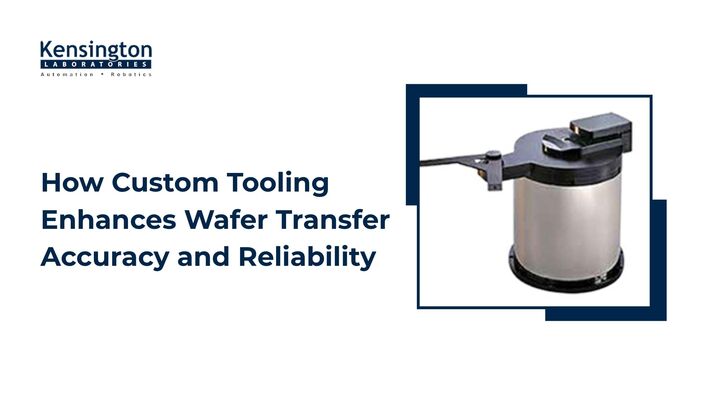
Standard off-the-shelf end-of-arm tooling often fails during more advanced chip fabrication steps. Generic components lack the specialized dynamics needed to handle fragile substrates as semiconductor nodes shrink and substrates become microscopically thin. Application-specific tooling integration matches vacuum pressure, mechanical contact points, and thermal thresholds to your process environment.
Edge exclusion zones can be dramatically reduced, and micro-vibrations during high-speed transfer can be avoided by deploying an atmospheric wafer handling robot with customized end effectors. Dedicated tooling for ultra-thin, warped, and high-temperature substrates directly controls yield stability.
Substrate Handling Dynamics
Standard grippers treat every wafer the same. Customized tooling adapts directly to substrate physics-
-
Contact dynamics- Edge-grip jaws, Bernoulli non-contact mechanisms, and tailored vacuum channels prevent physical surface contamination.
-
Thermal endurance- High-purity ceramics and specialized composites handle rapid temperature shifts without outgassing.
-
Vibration control- Balanced arm geometry cuts deflection during high-acceleration moves, stopping micro-slips inside handling chambers.
Global cleanroom buildouts continue expanding rapidly to support advanced packaging and smaller logic nodes. That aggressive manufacturing push proves why modern fab operators rely on targeted semiconductor automation to maintain strict output targets across continuous production runs.
Core Performance Gains
Standard tooling relies on basic flat-silicon handling, which falls short when modern production lines require precision wafer handling for fragile or ultra-thin substrates. That approach creates higher particle counts from mechanical friction and caps transfer speeds due to slip risks. Tailored end effectors support thin, compound, or glass substrates while using low-outgassing, ESD-safe materials. You get optimized grip profiles that let your transfer arms accelerate faster without damaging fragile edges.
|
Performance Factor |
Standard Tooling |
Application-Specific Tooling |
|
Substrate Compatibility |
Standard flat silicon | Thin, warped, compound, or glass |
|
Particle Generation |
Risk via mechanical friction | Low-outgassing, non-contact, ESD-safe |
|
Transfer Speed Limit |
Constrained by slip friction | Optimized grip for maximum acceleration |
Concluding Thoughts
Relying on generic end effectors leads to wafer slippage, particle contamination, and lost yield. Choosing application-specific tooling protects delicate substrates and keeps transfer speeds high across continuous production runs. Custom tooling engineered by specialized automation providers delivers the mechanical accuracy and cleanroom reliability needed for peak fab output.