5 Common Failures That Affect Precision Positioning Stages
Posted by Kensington Laboratories
Filed in Business 50 views
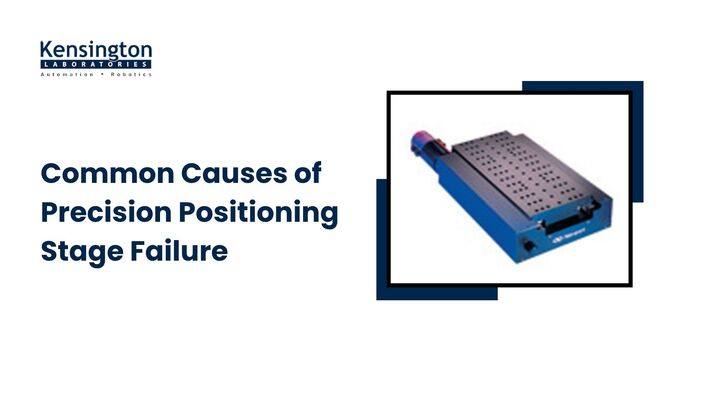
Sub-micron manufacturing processes rely heavily on structural motion mechanics. When automated alignment systems drift, entire process tools experience unrecoverable yield loss and sudden cycle degradation.
Understanding common precision stage failures helps tool designers and cleanroom operators maintain steady throughput without compounding mechanical damage. Early detection prevents catastrophic tool crashes and keeps high-value manufacturing lines fully operational.
Identifying system degradation relies on recognized symptoms. Timely precision XY stage repair resolves minor trajectory errors before structural wear damages delicate drives or optical components.
Root Causes of Positioning Stage Mechanical Breakdown
Structural wear, environmental changes, and electrical issues frequently disrupt standard tool alignment.
1. Mechanical Bearing Wear and Preload Degradation
Mechanical bearing tracks inside linear stages experience heavy friction over millions of continuous motion cycles. As lubrication breaks down, surface spalling and roller clearance changes alter the stage profile. This wear causes angular deviation, pitch errors, and uncompensated pitch-roll-yaw movements that degrade spatial placement.
2. Optical Encoder Contamination and Trajectory Drift
Precision motion rely on optical glass-scale feedback to calculate position down to nanometers. Airborne particulates, outgassed lubricants, or cleaning residue cloud readheads or obscure scale lines. Distorted feedback causes false trajectory corrections, positioning error, and system instability during rapid moves.
3. Drive Mechanism Backlash and Hysteresis
Recirculating ball screws and mechanical drive linkages experience axial slop over extended operation. This mechanical hysteresis causes position overshoot during directional changes. Uncontrolled backlash ruins motion smoothness and demands frequent motion stage troubleshooting to restore baseline trajectory parameters.
4. Thermal Expansion and Structural Warp
High-acceleration linear motors produce localized heat inside compact stage housings. Without thermal isolation or active cooling, expansion warps structural baseplates. This thermal growth causes sub-micron position drift, reducing multi-axis alignment repeatability across long manufacturing runs.
5. Servo Loop Tuning Instability and Resonance
Moving heavier payloads changes system resonance frequencies. If control loops are tuned for specific loads, changing mass causes structural vibration during settling phases. These lingering vibrations extend cycle times and cause alignment errors during high-speed wafer processing.
Mitigating Sub-Micron Alignment Errors
Modern semiconductor automation strategies favor predictive maintenance over scheduled mechanical overhauls.
Integrating real-time vibration sensors and automated temperature tracking helps engineers identify precision stage failures long before total breakdown occurs. Addressing structural resonance early preserves long-term tool health.
According to semiconductor capital benchmark analysis, predictive maintenance strategies in advanced fabrication plants drastically lower unexpected tool downtime, directly protecting high-volume yields and overall equipment effectiveness.
Concluding Thoughts
Preventing unexpected precision stage failures requires proactive monitoring, proper cleanroom hygiene, and rapid mechanical service. Prioritizing scheduled stage maintenance and tracking minor positioning errors keeps high-precision automated systems running at maximum efficiency without risking costly line stops.