What Is Driving the RF Front-End Chip Market from US$ 18.52 Billion to US$ 47.10 Billion by 2030?
Posted by Monica Scott
Filed in Other 641 views
An RF front-end chip is a key semiconductor component in wireless communication devices, enabling the efficient transmission and reception of radio frequency (RF) signals. Positioned between the antenna and the baseband processor, it performs essential tasks such as amplification, filtering, and signal switching to ensure stable, high-quality wireless connectivity.
RF Front-End Chip Market Size, Share, and Analysis
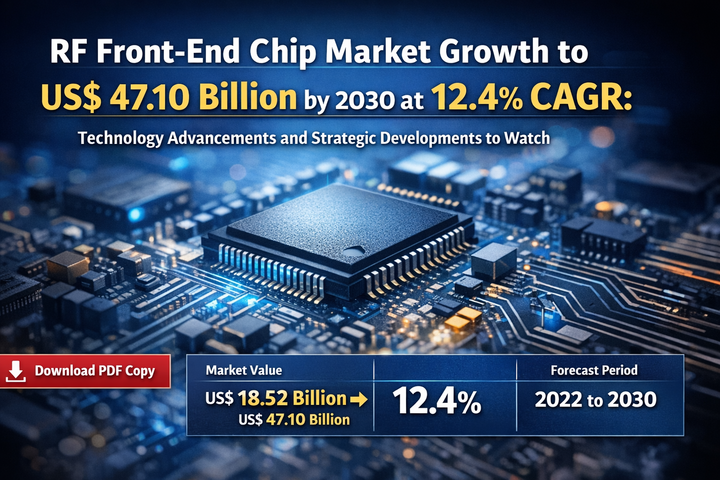
The RF front-end chip market is expected to witness strong growth, increasing from US$ 18.52 billion in 2022 to around US$ 47.10 billion by 2030, at a compound annual growth rate (CAGR) of 12.4%. This growth is largely fueled by rising demand for smartphones, tablets, and other consumer electronic devices, along with the global expansion of 5G networks. As a core component of wireless systems, RF front-end chips play a crucial role in enhancing signal quality, enabling higher data speeds, and improving energy efficiency in modern mobile devices.
Key Drivers of Market Growth
- Surging Demand for Consumer Electronics: The proliferation of smartphones and tablets is a key driver of the RF front-end chip Industry. According to GSMA's 2023 report, over 54% of the global population now owns a smartphone. The number of smartphones is expected to rise significantly, from 5.75 billion in 2020 to 7.15 billion by 2025. The increasing adoption of connected devices further fuels demand for RF front-end chips.
- Advancements in Wireless Communication: The rapid advancement of wireless communication technologies, particularly with the advent of 5G, has led to an increased need for RF front-end devices that support multi-mode and multiband operations. This trend enhances network connectivity and enables faster data rates.
- Miniaturization Trends: The ongoing miniaturization of RF front-end modules is expected to introduce new trends in the market. Compact designs are crucial for modern mobile devices, which require efficient and powerful RF solutions.
Market Segmentation
- Components:
- Power Amplifiers
- RF Switches
- Radio Frequency Filters
- Low-Noise Amplifiers
- Others
- Applications:
- Consumer Electronics
- Wireless Communication
- Others
Segmental Analysis
The power amplifier segment dominated the RF front-end chip Industry in 2022, attributed to its critical role in enhancing the power of RF signals. Recent product launches, such as RFHIC Corp's new line of SDM GaN Hybrid Power Amplifier Modules, underline the focus on developing advanced solutions for 4G LTE and 5G systems.
Get Sample Report@ https://www.theinsightpartners.com/sample/TIPRE00017165
Regional Insights
The Asia Pacific region leads the RF front-end chip market, driven by the demand for high-speed data connectivity and the proliferation of smartphones. Countries like South Korea, China, and Japan are at the forefront of 5G adoption, significantly boosting the demand for RF switches. The region's robust internet penetration, with over 2.9 billion users as of July 2022, further accelerates market growth.
Key Players in the RF Front-End Chip Market
- Infineon Technologies AG
- TDK Corp
- Texas Instruments Inc
- Broadcom Inc
- Qorvo Inc
- Skyworks Solutions Inc
- STMicroelectronics NV
- Murata Manufacturing Co Ltd
- Microchip Technology Inc
- NXP Semiconductors NV
Future Outlook
Looking ahead, the RF front-end chip market is expected to continue its upward trajectory. Innovations in technology, particularly in 5G, IoT, and AI, will further drive demand for advanced RF solutions. The increasing emphasis on seamless connectivity and high data transfer speeds will push manufacturers to develop more sophisticated RF front-end technologies. Additionally, as consumer preferences evolve towards smarter and more connected devices, the market will likely witness a surge in demand for versatile and efficient RF front-end chips. Companies that adapt to these trends and invest in research and development will be well-positioned to capitalize on the burgeoning opportunities within this dynamic market.
Frequently Asked Questions (FAQs)
1. What is an RF front-end chip?
An RF (Radio Frequency) front-end chip is a semiconductor component that manages signal transmission and reception in wireless devices. It typically integrates power amplifiers (PA), low-noise amplifiers (LNA), RF switches, filters, and duplexers to ensure efficient communication.
2. How does 5G impact the RF front-end chip market?
5G technology requires more complex RF architectures, higher frequency bands (including mmWave), and advanced filtering solutions, significantly increasing demand for RF front-end components.
3. What are the key components of an RF front-end module?
An RF front-end module generally includes:
- Power amplifier (PA)
- Low-noise amplifier (LNA)
- RF filters
- RF switches
- Duplexers and multiplexers