How Much Does Foam Board Insulation Cost?
Posted by Victoria Joan
625 views
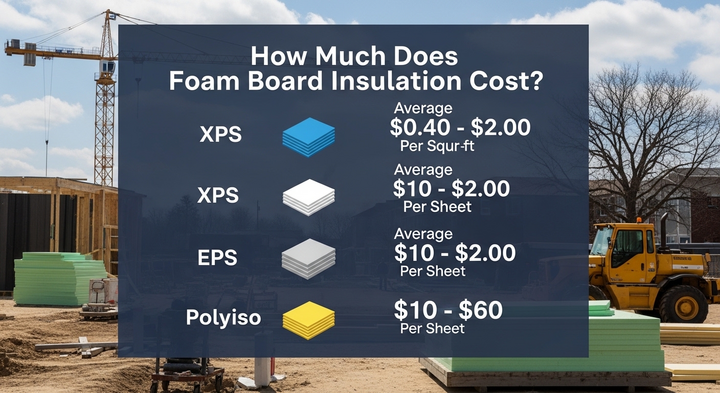
Across the United States, foam board insulation is the first option for many homeowners who want to increase energy efficiency and comfort in their homes. The cost for the materials fluctuates, generally staying within the range of $0.3 and $3 per square foot, and with the addition of professional installation, the total may vary from $1.5 to $5.5 per square foot, depending on the location, the kind, and the thickness of the board. Foam boards are the most versatile since they can be constructed from EPS, XPS, or Polyiso, and their use is not limited only to walls, but they can also beused for roofs and basements to offer a great deal of insulation and protection against moisture.
Homeowners who plan to undertake large-scale projects locally need accurate cost planning to move forward with confidence. Precise insulation estimates allow them to clearly understand the total amount required for insulation services and materials before work begins, helping avoid budget overruns and ensuring proper takeoff calculations for a smooth project execution.
Foam Board Insulation: What Is It?
Foam board insulation is a category of equipment that comprises id panels that are mainly used for lowering the thermal conductivity of buildings and regulating the usage of air conditioning and/or heating systems. These are not the same as loose-fill or batt insulation, as foam boards are solid sheets that, by their very nature, have a high resistance to thermal transfer. Their application has been extended to the external walls, the areas beneath concrete slabs, the basements, and the attics of houses.
They are the most common ones used in the United States are:
1. EPS (Expanded Polystyrene): EPS is an affordable choice for parents and is widely available all over the country. In exchange for its low cost, this material offers mid-level thermal resistance with an R-value of about 3.6-4.0 per inch.
2. XPS (Extruded Polystyrene): As a water-resistant and durable material, XPS can offer about 5 R-values per one-inch thickness, thus making it perfect for areas that are at risk of humidity.
3. Polyiso (Polyisocyanurate): Is the one to have the highest R-value in the range of 5.6-6.5 per inch and is mostly selected in the case of commercial buildings or other similar instances where a great degree of thermal insulation is required.
Foam board insulation is very easy to handle in terms of cutting and installing it, which is why people who like to carry out home projects on their own are attracted by it; however, the work of a professional may still be needed if the installation is large or complicated.
Factors Affecting Foam Board Insulation Cost
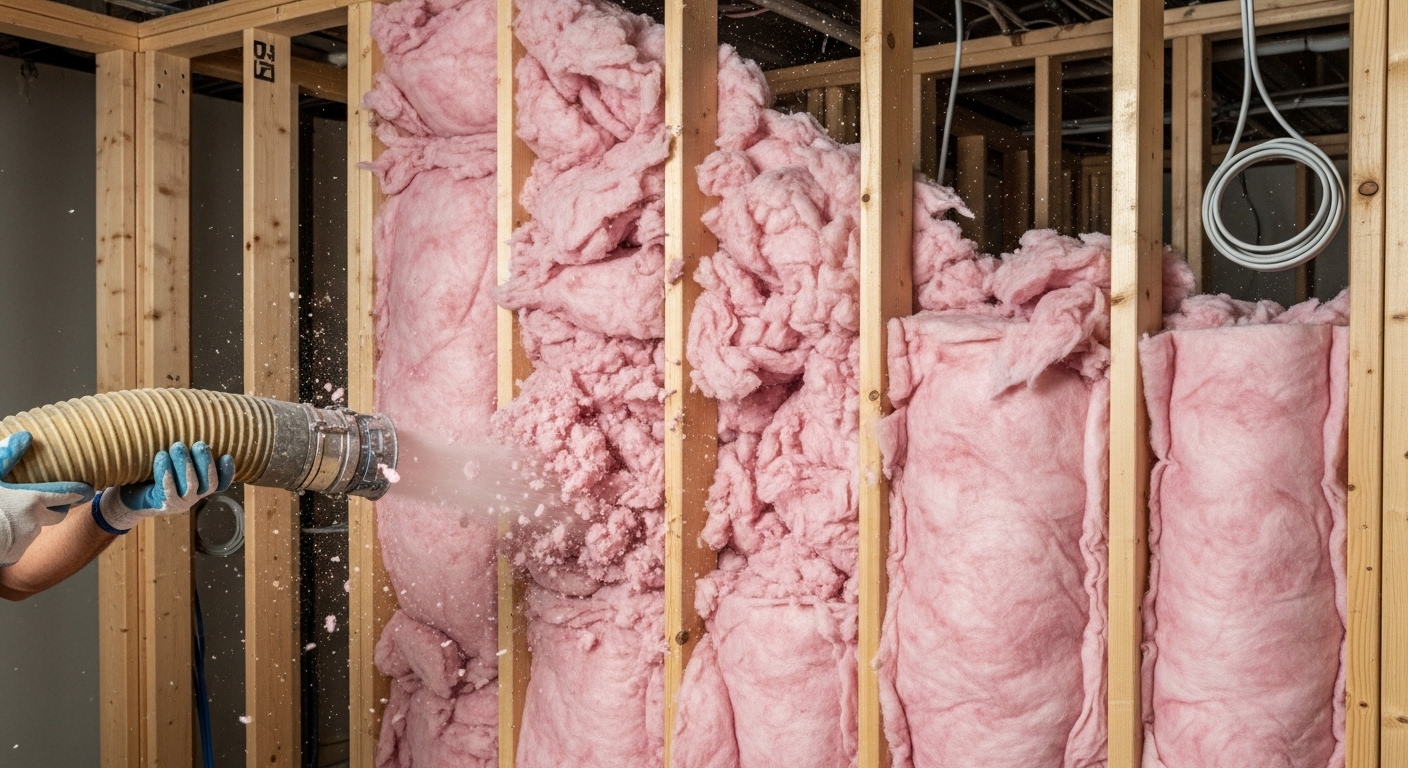
Various factors determine the overall foam board insulation price in the U.S.:
Material Type and Thickness: Different materials offer different R-values, which affect the thickness necessary to meet energy codes. As a result, XPS requires less thickness than EPS to have the same thermal resistance.
Project Size and Area: The bigger the area, the more boards will be needed, thus both the material and labor costs will increase. Large installations, such as basements or roofs, can noticeably increase the total costs.
Labor Costs: Professional installation costs vary depending on the region, with labor rates being higher in metropolitan areas. The labor cost can make up between 30 and 50% of the total installation costs.
Complexity of Installation: Simple wall installations are, in most cases, cheaper, whereas the labor required for irregular spaces, ceilings, or rooflines is more time-consuming and thus costly.
Local Climate and Energy Codes: Houses located in colder areas may need higher R-values, which affects both the type and the thickness of the boards used.
Homeowners can avoid surprise expenses and get better insulation performance if they consider all these factors. Partnering with contractors who provide accurate estimating services is a way of ensuring that every detail, from materials to labor, is taken into account.
Typical Foam Board Insulation Costs in the US
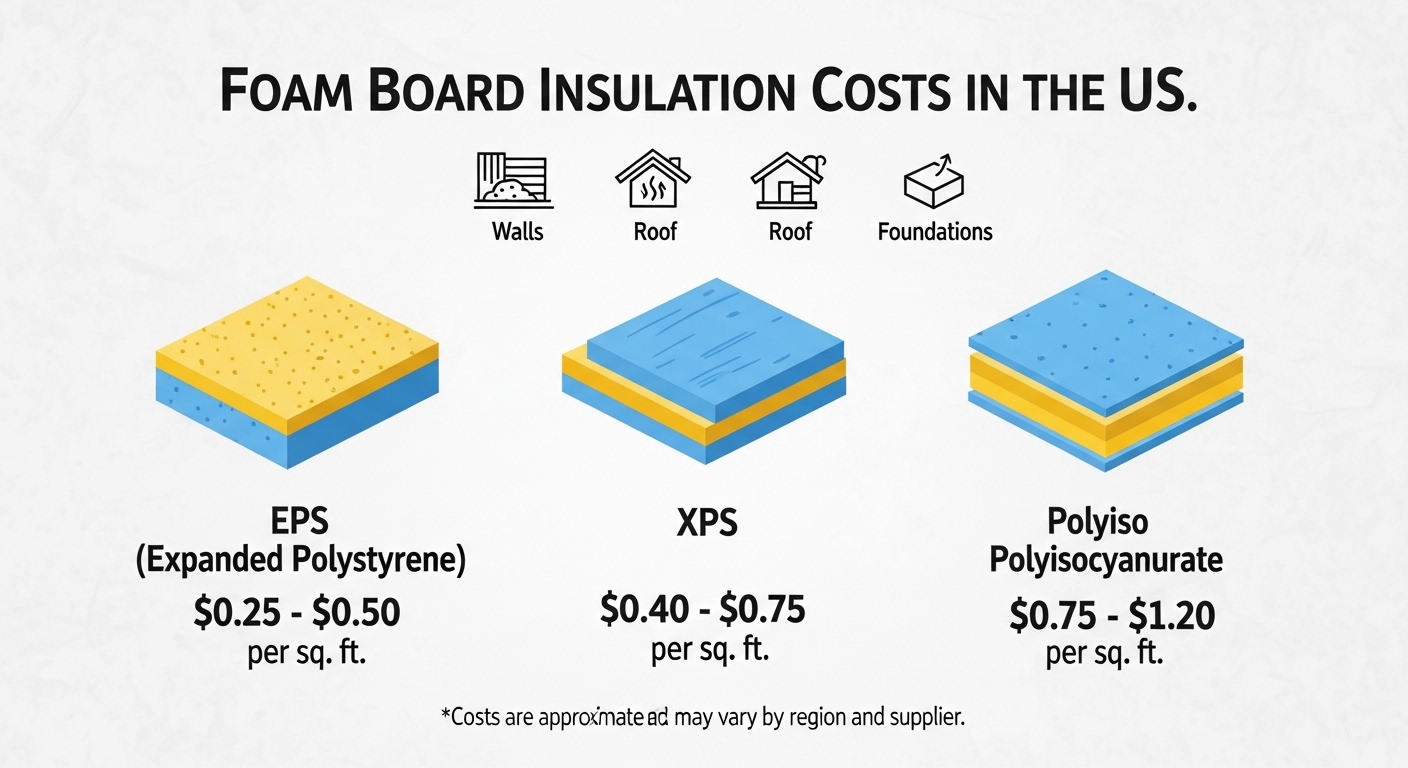
Here is a table that shows typical cost ranges for foam board insulation in the US, both for materials alone and with installation:
|
Foam Board Type |
Material Cost (per sq ft) |
Installed Cost (per sq ft) |
Typical R-Value per Inch |
|
EPS |
$0.30 – $1.00 |
$1.50 – $3.00 |
3.6 – 4.0 |
|
XPS |
$0.80 – $2.50 |
$2.50 – $5.00 |
5.0 |
|
Polyiso |
$1.50 – $3.00 |
$3.00 – $5.50 |
5.6 – 6.5 |
Material prices are not fixed, as they vary with several aspects such as thickness, density, and even the size of the board. As an example, a thicker XPS board could be more expensive at first, but this would take up fewer layers of boards to meet insulation standards, which in the end would save money both in labor and materials.
Benefits of Foam Board Insulation
The usage of foam board insulation is good for US homeowners as it offers several benefits:
Energy Efficiency: When the foam boards are installed properly, they help to reduce the heating and cooling costs by 10–20%. The result is also dependent on the home’s climate zone.
Moisture Resistance: The plastic foam (XPS) and Polyiso boards do not allow water to penetrate them easily, hence they are the perfect insulation materials for basements and outer walls.
Durability: The period for which foam boards are usable is between 20 and 30 years when installation is done properly, thus they can be regarded as reliable materials.
Ease of Installation: Since the boards are of very low weight and cutting through them is a simple task, they flatly match the capabilities of a DIY project.
Compatibility with Other Insulation: Foam boards may be worked together with fiberglass or spray foam to achieve a high level of thermal performance in areas where it is necessary.
With these advantages, foam boards become a feasible option in the field of residential and commercial building projects.
Common Applications of Foam Board Insulation
The usage of foam boards is not limited to one home part but rather extends to various home segments:
Walls: Besides lowering thermal bridging, outer walls can achieve a higher insulation value.
Roofing & Attics: Adding foam insulation to the attic increases thermal resistance, helping prevent heat loss in cold areas. Accurate material planning and cost analysis for such upgrades are typically handled by roof estimators, who provide detailed estimating services and takeoffs to ensure efficiency and budget control.
Basements & Foundations: What a relief it is to come back to dry and everlasting basements with the installation of moisture-resistant boards.
Under Slabs & Crawlspaces: A layer of foam beneath your slab or in your crawlspace ventilates your home from moisture and temperature fluctuations coming from the ground.
Combination Projects: The use of foam boards in combination with other types of insulation can be layered to achieve the highest level of energy efficiency.
FAQ
Q1: What is the best type of foam board insulation for US homes?
A1: XPS offers the best combination of R-value and moisture resistance for most climates, while EPS is budget-friendly, and Polyiso is ideal for high-performance applications.
Q2: Can I install foam board insulation myself?
A2: Yes, it is DIY-friendly for walls and floors, but complex areas or large-scale installations may require professional help.
Q3: How much energy can I save with foam board insulation?
A3: On average, homeowners can save 10–20% on heating and cooling bills, depending on local climate and installation quality.
Q4: How thick should my foam board insulation be?
A4: Typically, 1–2 inches for walls, and 2+ inches for basements or roofs, depending on R-value requirements.
Q5: Is foam board insulation better than fiberglass?
A5: Foam boards provide higher R-values per inch and better moisture protection, but combining them with fiberglass can maximize overall efficiency.