Protecting Candles with Thoughtfully Designed Packaging
Posted by Harry Harry
Filed in Business 28 views
A friend of mine runs a small candle business out of her garage, sells mostly through farmers’ markets and a shopify site on the side. About two years in she told me something that stuck with me she said her biggest expense wasn't wax or fragrance oil or even the glass jars. It was replacing candles that arrived broken. Cracked jars, wax that had shifted and cracked on top from temperature swings, lids that popped off somewhere between her porch and someone else's. She was basically eating the cost of a percentage of every order just from bad packaging.
That's not a rare story either, once you start asking around. Candles are heavier than people expect for their size, they're made of glass more often than not, and they're fragile in a couple different ways that aren't obvious until you've shipped a few hundreds of them and started tracking what comes back damaged.
Why candles are actually harder to package than they look
A candle jar isn't like most other products going through a shipping network. You've got glass, which cracks or chips on impact. You've got wax, which is solid at room temperature but softens and can shift if a box sits in a hot delivery truck for a few hours, then re-hardens unevenly, leaving a sunken or cracked top that looks like a manufacturing defect even though it happened entirely in transit. And you've got a lid, sometimes wood, sometimes metal, sometimes just a loose-fitting cork, that can pop off if the box gets tossed around or turned upside down, which happens more than any of us would like to think given how packages actually get handled once they leave a warehouse.
Standard packaging, a folding box with maybe some tissue paper stuffed around it, handles none of this well. It protects against dust and light scuffing, sure, but it does basically nothing against impact or the jar shifting during a rough handoff between carriers. Candle jar boxes built with the actual physics of the product in mind are a different thing entirely, and the difference shows up directly in return rates.
What a properly designed candle jar box actually needs
A snug, jar-specific interior
This is the part that matters most and gets skipped most often, usually because it's the most expensive part to get right. A box that's just slightly larger than the jar with some crumpled paper stuffed in the gaps isn't real protection, it just delays the jar hitting the box wall by a few inches. A custom insert, molded pulp or die-cut cardboard, that holds the jar in a fixed position stops that shifting entirely. The jar can't move, so it can't build up momentum before it hits anything.
Enough structural strength in the outer box itself
This comes down to flute grade again, similar to what applies with shipping mailers generally, but it matters more here because of the weight glass jars carry. A single-wall box that's fine for a t-shirt is often not enough for a full candle jar, especially if a customer's ordering multiples and they're getting bundled into a bigger shipping carton where they're now bearing weight from other stuff stacked on top.
Ventilation and cure-time consideration
A candle that's boxed up too soon after pouring, before the wax has fully cured and the fragrance oil has fully bonded, can actually sweat inside a sealed box. That shows up as a slightly oily film on the jar or, worse, a scent that's noticeably weaker than it should be by the time it reaches the customer. This isn't really a box design problem so much as a timing problem, but it's worth candle makers hearing it from a packaging conversation because it gets missed constantly, and no box design fixes wax that got sealed up too early.
A lid that actually gets secured
Depending on what kind of lid the candle uses, this might mean a small piece of tape holding it in place during transit, or a box insert with a dedicated slot that keeps the lid from sliding independently of the jar. Sounds minor. It's one of the most common damage complaints in candle shipping anyway, a lid that arrived separated from the jar and rattling around loose.
The gifting side of this, which pulls in the opposite direction a little
Here's the tension that candle brands run into constantly. Everything above is about protection, and protection generally wants simple, functional, tightly-fitted packaging. But candles get bought as gifts a huge amount of the time, way more than most product categories, and gifting wants packaging that feels special, that has some presentation value, that doesn't look like it was built purely for surviving a delivery truck.
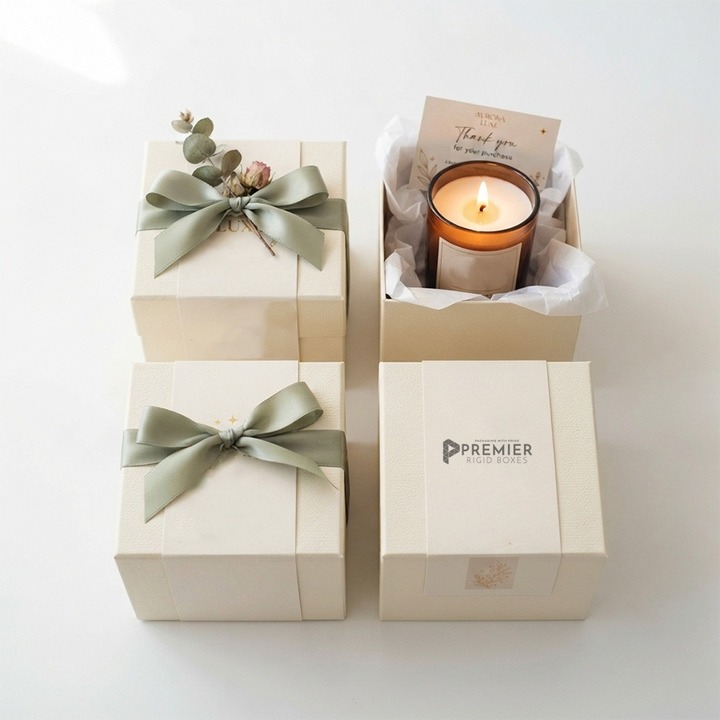
The better candle jar boxes manage to do both, but it takes more design work than picking one or the other. A rigid or semi-rigid outer box with a printed sleeve or wrap gives you the presentation layer, while a fitted interior insert underneath handles the actual protection. The customer sees the nice exterior first, so the gifting impression lands, but the jar itself is sitting in something engineered around its actual weight and shape rather than just floating in tissue paper. It costs more to design and produce than either extreme on its own, no way around that, but for a brand where both damage claims and gifting appeal matter, it tends to be worth it.
Where I'd actually push back on some of what's out there
A lot of packaging content treats box design purely as a branding exercise, all about unboxing videos and Instagram moments, and completely skips the actual engineering side. That's a mistake for candles specifically, more than for most products. A gorgeous box that lets a jar arrive cracked isn't a branding win, it's a return, a refund, a bad review, and often a customer who doesn't order again. The presentation matters, genuinely, but it has to sit on top of a box that actually does its job, not instead of one.
On the flip side, I've also seen candle makers, especially newer ones working with tight margins, go too far the other way and treat packaging as a purely functional afterthought, a plain brown box with a sticker slapped on. That undersells a product that took real time and materials to make, and it leaves money on the table in a category where a meaningful chunk of buyers is shopping specifically for something that feels gift able.
Final Words
If you're a candle brand looking at your packaging for the first time, or reconsidering it after too many damage claims, start by actually tracking what's going wrong. Cracked jars versus shifted wax versus separated lids versus something else entirely are different problems with different fixes, and it's easy to guess wrong about which one is actually costing you the most without pulling the data. From there, a fitted interior insert is usually the highest-impact single change, more than upgrading the outer box material or the print quality. Get that right first, then layer in the presentation side once the protection is actually solid.
My friend with the garage candle business ended up switching to a custom insert about a year after that conversation. Her damage rate, by her own count, dropped by more than half. She still complains about the upfront cost of the tooling for the insert. But she's stopped eating the cost of replacing broken jars every month, which is the kind of trade that's easy to see in hindsight and harder to justify before you've actually made it.